On Extending a Framework, Defining a Mechanic, and Doing the IP Work. Plus a free PDF
This piece was originally published on the Soulwork Newsletter via Substack on Jun 24, 2026. It has been edited for clarity.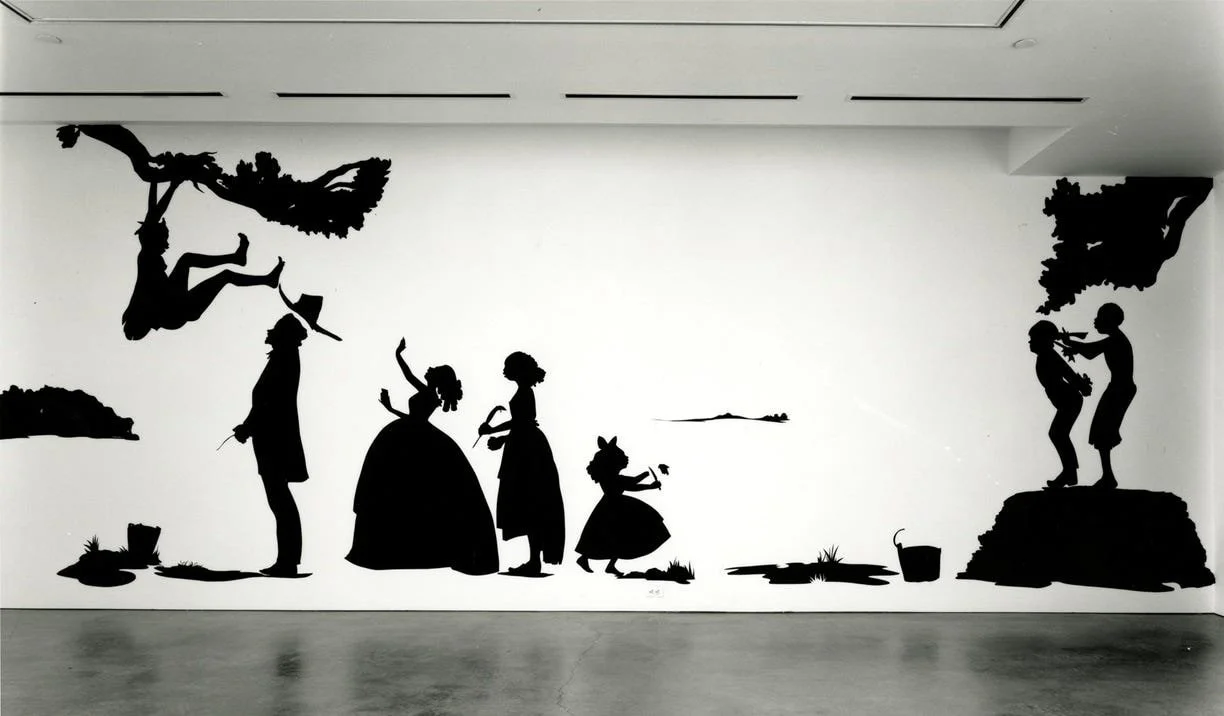
Look Away! Look Away! Look Away!! Kara Walker. Using an old art form from popular culture–silhouettes cut from black paper–Kara Walker creates works to be a commentary on the history of slavery and race relations. Her elegant and strong images and stories appeared to be culled from historical romance novels.
I’ve been pretty MIA on Substack of late. Primarily because I am writing my memoir, and trying to figure out how I’m going to make a living in this post-op fascist hellscape. But a couple of weeks ago I wrote an essay called What About the Sad Black Woman, and it’s been doing rounds.
In that essay, I coined the term controlled absence. And I really think I’m on to something.
A few weeks later, in a completely different context, I was thinking about the specific texture of growing up Black and girl in a world that cannot decide whether one is a child or a resource. And I realized without meaning to that I was looking at another controlled absence. This one was operating on a different register than sadness. And it was enforcing a different prohibition. But it felt like the same mechanic.
A controlling image operates by substitution. It puts something false in the place of something true. Patricia Hill Collins named the Mammy, the Jezebel, the Sapphire, the Matriarch, and the Strong Black Woman*. Each one is a legible fiction with a political function. Because controlling images are legible, they can be refuted.
A controlled absence operates differently.
A controlled absence works by removing a human capacity, developmental stage, or affective state from the field of visibility and legitimacy.
It does not replace what it takes.
The nothing that controlled absences leave behind is productive. If society and policy demand the absence of sadness, they create a subject who does not require the overhead of social care, comfort, or protection. The vacuum is the point.
This is what makes controlled absence harder to name and harder to contest than a controlling image. It is legible only through negative space. It can only be mapped through the shape of the gap, and the pattern of what keeps not appearing. There is no image to refuse.
Every controlling image functions on two tracks simultaneously. The first track is representational: it tells the world what you are. The Mammy is an asexual Black woman who is happy to serve white society, has no needs of her own, and is, in effect, de mule o’ de wuld. The second track is regulatory: it tells you what you are not permitted to feel, need, or become. Collins named the first track. Controlled absence lives on the second. And the prohibition that produces it does not have to come from a controlling image at all. It can come from institutions, labor markets, family systems, or cultural scripts. Anywhere power has an interest in your vacancy.
Over time the prohibition does not stay external. It becomes the architecture of interiority. The absent thing becomes illegitimate even in the private self. This changes what reclamation requires. You cannot simply give yourself permission to feel a thing you don’t recognize as yours to feel.
That is the mechanic of controlled absence. That is what I was naming in my first essay.
I want to give you a tool, not just a term.
I made a lil PDF that defines controlled absences more concretely, and runs you through the diagnostic more simply. Grab yours here
I am not done with this concept. Frameworks are only useful if they travel, and I can already feel where this one wants to go: the disabled Black woman, the BW novice, Black girlhood. Those pieces are coming. And this is where they’ll live — because some concepts need a room to grow in before they’re ready for the academy. This is that room.
But I needed this first. The floor before the rooms.
The next few pieces will take it somewhere. Stay close.
Footnotes
1 On Collins: Black Feminist Thought (1990; 2nd ed., Routledge, 2000) is a foundational text for Soulwork. It goes well beyond controlling images into the full architecture of how Black women’s knowledge, labor, and inner life are organized under power. Start there.