On The Black Women Pushed Out Of The Labor Force, Algorithmic Monoculture, and The Exit Project
This spring, Stanford researchers published a study that proved something everyone who has applied for a job recently already suspected: during the arduous application process, a human being probably never sees your name.
Analyzing four million applications across 156 employers screened by the vendor Pymetrics, the study documented the architecture of algorithmic monoculture. They found that independent companies have, in several cases, outsourced their hiring to the exact same software. The results were troubling: over 25% of applications from Black candidates went to roles that met the legal threshold for adverse impact, and 4% of applicants who applied to ten different positions were rejected by every single one. That 100% rejection rate acts as a synchronized blacklist. Literally and metaphorically.
Algorithmic Monocultures In Hiring* got accepted to FAccT. That's a conference literally named for fairness, accountability, and transparency, run by ACM, the computing field's own professional society. The paper itself came out of Stanford, the same kind of institution training the engineers who'll build the next version of the system it studied. The industry can prove its own machine discriminates, and yet, it still hasn't stopped.
Because why would it? Fixing algorithmic monoculture means giving up centralized power and profit. It's much easier to pivot the conversation to freaking out about rogue superintelligence and funding sci-fi alignment research*. When over 350 AI executives and researchers, Sam Altman among them, signed a 2023 statement declaring AI an extinction risk on par with nuclear war, Dylan Baker of the Distributed AI Research Institute called it what it was: self-serving hype disguised as raising the alarm. Silicon Valley would rather play savior against an imaginary apocalypse tomorrow than fix the very real, discriminatory dystopia it is scaling today.
But for all its data, the Stanford study cannot name a single one of the women inside that four percent of applicants. Their data is not sliced in a way that allows us to glean insights about Black women specifically.
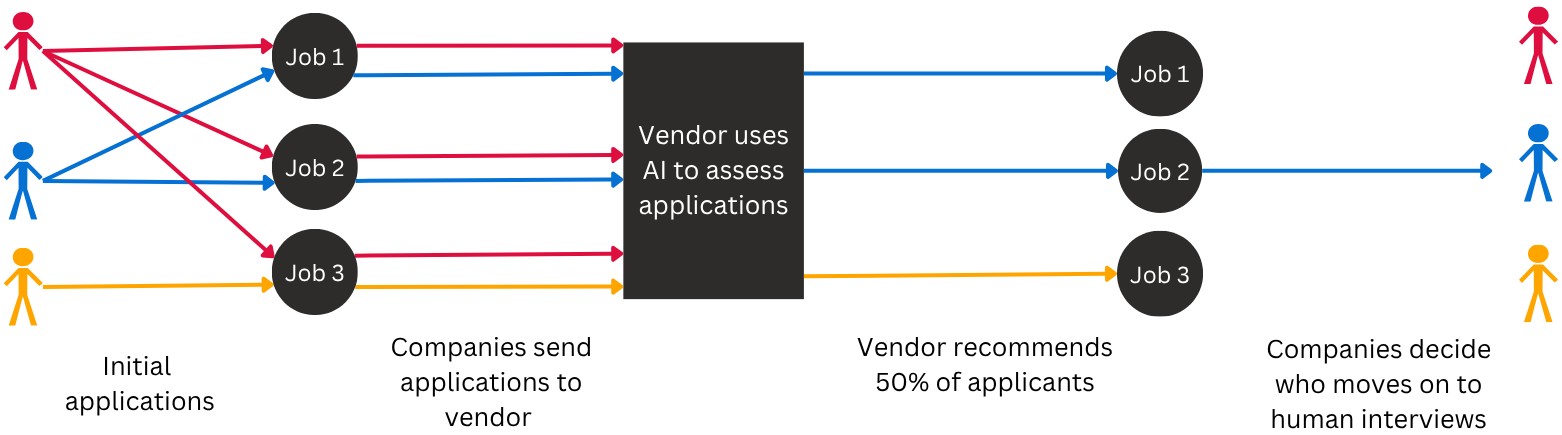
Source: Algorithmic Monocultures in Hiring. Linked in footnotes below. Job applications are assessed by hiring AI to be recommended or not recommended. If an applicant is not recommended by the algorithm, they are likely to be rejected without further consideration by a human.
What does it mean to be counted and never named?
What is owed to a woman who was pushed out of the labor force due to tariffs, or DEI policy changes, or federal cuts? What is owed to her after she applied to 84 jobs in 6 weeks, and heard nothing back from any of them? How many silences must she bear before the silence itself becomes the message?
Can a disparate impact ratio hold what she told herself on the 85th try? That it was her résumé. Her photo. The gap in her employment history she never explained quite right.
Does knowing that Katica Roy's analysis counts her among the 600,000 Black women pushed out of the labor force comfort her, or make her discouraged? Is algorithmic monoculture connected to the women who cannot, or will not, reenter the labor force?
A dataset can document that she was excluded. It cannot document what she was thinking about when it happened. Who she called after. What she told her mother. Whether she blamed herself before she'd ever heard the word "monoculture." If she started a business, got a new job, turned to unpaid care labor, or simply went mad in response to the exclusion. Or if she considers herself pushed out, or if she left.
Someone has to ask her. Someone willing to sit with the answer long enough to let it stay complicated, unresolved, and still count as evidence.
I volunteer.
When this work began during the Great Resignation, it was called the Voluntary Exit Project. I dropped "voluntary" from the title as my first major finding. The data quickly showed that the boundary between choosing to leave and being pushed out is rarely clean.
In the first wave of The Exit Project, I spoke to scores of women who laid the foundation for everything this project has become. They gave me the methodology for Wave 2. It was their testimony that revealed the five core domains the study now tracks: how the departure actually happens, the tipping point of the decision, the emotional and psychological toll, how they reclaimed their agency, and the structural forces that pushed them out.
That throughline is exactly what this moment requires. Every earlier wave documented an exit with a face attached to it. There was a manager, a memo, or a decision someone could point to and name. Algorithmic monoculture doesn't leave a face behind. It leaves a vendor nobody sees and a rejection nobody can trace to a single choice. That makes individual testimony matter more now than it did when this project started. It may be the only record an invisible mechanism leaves.
Mapping the 2025 Mass Displacement
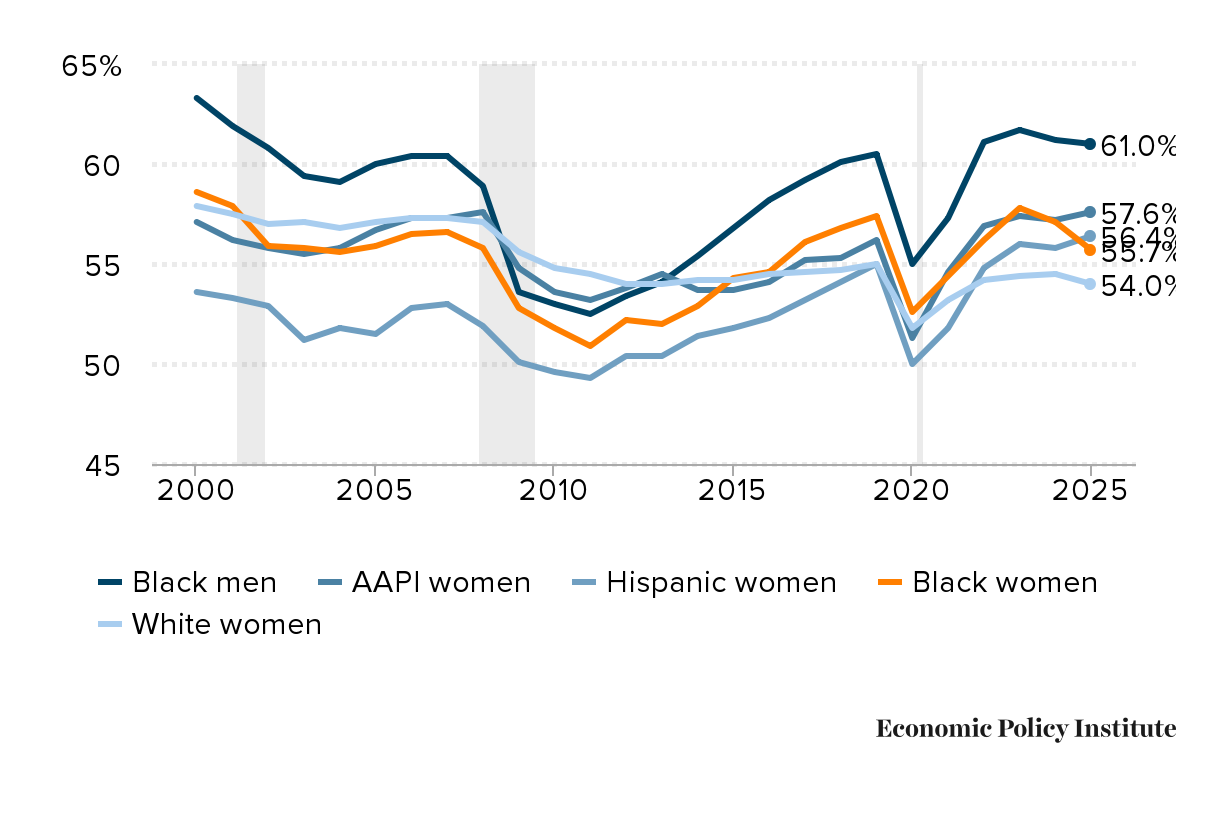
Source: Economic Policy Institute, State of Working America Data Library, "Employment by demographics - Employment-to-population ratio," 2026.
Economist Katica Roy's analysis puts the number at 600,000 Black women pushed out of the labor market since January 2025. I'm using her figure instead of the more conservative 251,000 that the Institute for Women's Policy Research pulled directly from BLS data on jobs lost between January and August, and I want to say plainly why: the smaller number only counts the cleanest kind of exit, a job that existed and then didn't. This project exists because that has never been the only kind of exit that happens. A woman who stopped applying because the algorithm made it pointless, or who left a role that technically still existed because staying became untenable, doesn't show up in a jobs-lost count. She shows up, if she shows up anywhere, in Roy's broader number. Six hundred thousand is the more honest figure for what this project was built to document. Even though, or maybe because, it's the harder one to verify down to the decimal.
The three pressures of federal layoffs, DEI rollback, and a hiring system already screening on the other side of both don't stack neatly, and I'm not going to pretend they do. Untangling exactly which one moved first, or how much weight each carries in any single woman's exit, may not be possible. It may not even be the right question. What's certain is that none of them happened into a neutral hiring process. Whatever pushed her out, she came back to a labor market that had already decided who was excludable before she applied.
I am an independent researcher doing this work for the community — not for a corporation, an HR firm, or an academic PR machine. This isn't corporate risk management.
I quit my own job once, without a plan, sure and terrified in the same breath, and I still don't have a clean account of why — how much of it I chose, how much of it I was pushed toward by pressure too diffuse to name as any single decision. I don't expect this project to produce a clean account for me. I'm not asking anyone who writes in to have one either.
Footnotes
1 Algorithmic Monocultures in Hiring [https://arxiv.org/pdf/2605.27371]
2 FAccT — the ACM Conference on Fairness, Accountability, and Transparency, where the Bommasani et al. study was presented (FAccT '26, June 2026, Montreal).
3 Katica Roy's analysis, cited in Alexanderia Haidara, "600,000 Black Women Pushed Out of the Workforce: New IWPR Report Examines Why," The Black Wall St Times, August 5, 2026 — https://theblackwallsttimes.com/2026/08/05/600000-black-women-pushed-out-of-the-workforce-new-iwpr-report-examines-why/ [ https://www.fortune.com/author/katica-roy/page/1/]
4 Institute for Women's Policy Research, "One Year Into Trump's Second Term, Black Women Face Disproportionate Job Losses" — https://iwpr.org/articles/one-year-into-trumps-second-term-black-women-face-disproportionate-job-losses/
5 Dylan Baker (Distributed AI Research Institute), quoted in "Big Tech's Latest AI Doomsday Warning Might Be More of the Same Hype," Popular Science, 2023 — https://www.popsci.com/technology/ai-warning-critics/. Emily M. Bender and Alex Hanna, "AI Causes Real Harm. Let's Focus on That Over the End-of-Humanity Hype," Scientific American, June 2023 — https://www.scientificamerican.com/article/we-need-to-focus-on-ais-real-harms-not-imagined-existential-risks/